Seventh generation (LF)
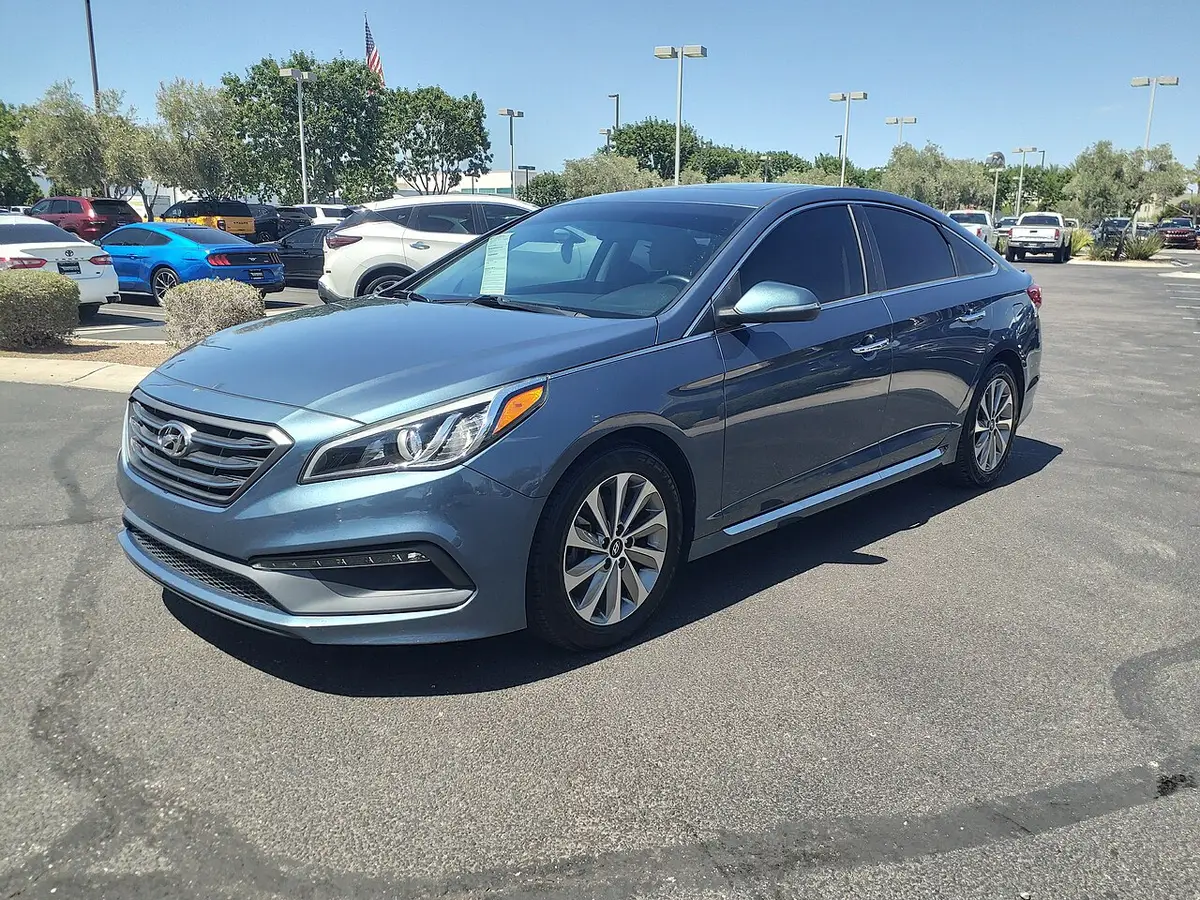
2017 Hyundai Sonata
The most reported problem on the 2017 Hyundai Sonata is engine failure, with 147 complaints, usually around 83,000 miles.
- 764owner complaints
- 3recalls
- 28involved a crash
- 53,000median miles at failure
Newest report Sep 22, 2026 · checked Oct 2, 2026
What is your Sonata doing?
Each one opens a sheet built from the owner reports of that problem on the 2017 model year.
Is the 2017 Hyundai Sonata reliable?
The 2017 Hyundai Sonata has 764 owner complaints on file with NHTSA, 4.3 times the median of 178 for 2017 sedans on this site. Of the 12 Sonata model years since 2014, it has the 2nd most complaints. Complaint counts rise with sales as well as faults, so read what owners report below before deciding.
At a glance
- Next to the 2016 and 2018
- At 76 complaints for each year on the road, the 2017 runs above the 2016 (66) and 1.8 times the 2018 (41).
- Top problem
- Two problems run close. Engine failure has 147 complaints and oil consumption has 131, out of 764 in all. A quarter of the 63 owners who gave a mileage for engine failure saw it by about 15,000 miles, and half by about 83,000.
- Crash, fire and injury reports
- 38 of the 764 complaints (5%) report a crash, a fire or an injury, about the 6% typical of vehicles on this site. Counted separately (one report can carry more than one), 28 reports mention a crash, 11 mention a fire and 12 people were hurt. The reports record 1 death. The most crash reports, 9 of 28, fall under airbag.
- Recalls behind the top problems
- No recall on file is on the same system as engine failure, oil consumption and stalling. For those, the complaints are all there is.
- When owners filed
- Filings peaked in 2022 at 131 and have dropped every year since, to 92 in 2025. So far in 2026, 47 more have come in.
When each problem shows up
Each bar covers the middle half of the mileages owners reported for that problem. A quarter saw it earlier, a quarter later. The tick is the median. Most reported: engine failure, knocking or rod bearing, 147 complaints.
middle half of reports, median tick. The heavier grey bars have 75 or more reports.
Behind you
Around your mileage
Ahead of you
How this compares
764 complaints is 2.8 times the median 2017 model on this site and 4.3 times the median 2017 sedan. Among the 11 Sonata model years here it ranks 2nd for complaints. Counts follow sales volume as much as reliability, so a truck that sells 700,000 a year draws more reports than a sedan that sells 200,000.
Service bulletins for the 2017 Hyundai Sonata
Hyundai filed 228 bulletins and other notices with NHTSA that list the 2017 Hyundai Sonata. 24 of them deal with a problem owners have reported on this car. Newest first.
Federal rules make a manufacturer send NHTSA a copy of any notice about a defect that goes to more than one dealer or owner. Most of these are service bulletins, the repair instructions manufacturers send to dealers. NHTSA generally leaves safety recall bulletins out of this file, and recalls are listed separately.
Engine failure, knocking or rod bearing 3 bulletins · 147 complaints
Applicable vehicles with 2.0L T-GDI and 2.4L GDI engines may experience the Check Engine warning lamp illuminated with DTC P1326 and/or engine may exhibit Abnormal Noise or No Crank/No Start condition.
Applicable vehicles with 2.0L Turbo and 2.4L GDI engines may experience the Check Engine warning lamp illuminated with DTC P1326.
1 more on this problem
Hyundai has refined the engine inspection for vehicles that experienced the Check Engine light with DTC P132600 to eliminate the interference caused by the wiring harness.
Engine stalls or loses power while driving 1 bulletin · 116 complaints
If you are servicing a vehicle with a transmission slipping concern, follow the Service Procedure shown below and perform a stall test. This TSB provides a procedure to test each clutch in the transmission.
Check engine light or misfire 7 bulletins · 106 complaints
Hyundai has launched a Service Campaign for applicable vehicles with 2.0L Turbo and 2.4L GDI engines that may experience the Check Engine warning lamp illuminated with DTC P1326.
If you are servicing an applicable vehicle with a âCheck Engineâ light on and one or more of the DTC listed below, follow the repair procedure and replace the related solenoid and oil pressure harness.
5 more on this problem
If you are servicing a vehicle with the DTC or symptoms listed below, refer to the Service Procedure to diagnose the condition.
Hyundai has launched a Service Campaign for applicable vehicles with 2.0L Turbo and 2.4L engines that may experience the Check Engine warning lamp illuminated with DTC P1326.
Applicable vehicles with 2.0L Turbo and 2.4L engines may experience the Check Engine warning lamp illuminated with DTC P1326.
This bulletin describes the service procedure to replace the inhibitor switch. A possible symptom is Diagnostic Trouble Code P0705 (Transmission Range Sensor Circuit).
Some 2017MY SONATA HYBRID (LF HEV) and Plug-In Hybrid (LF PHEV) vehicles may develop an abnormal noise, Hybrid/Check Engine Warning Light On and/or Engine No Start if the pulley becomes loose at the Hybrid Starter Generator (HSG) shaft.
Power steering cuts out or goes heavy 3 bulletins · 88 complaints
The warranty coverage for certain 2015-2017MY Sonata (LFa) and Sonata HEV/PHEV (LF HEV/PHEV) vehicles exhibiting reduced power steering assist and/or motor driven power steering (MDPS) warning lamp has been extended to 15 years or 150,000 miles from the date ...
The warranty coverage for certain 2015-2017MY Sonata (LFa) and Sonata Hybrid/Plug-in (LF HEV/PHEV) vehicles exhibiting reduced power steering assist and/or motor driven power steering (MDPS) warning lamp has been extended to 15 years or 150,000 miles from the ...
1 more on this problem
Certain vehicles may develop a bearing noise within the Motor Driven Power Steering (MDPS) column worm shaft assembly. If bearing noise is heard, follow the procedure in this bulletin to replace the worm shaft bearing.
Engine knocking or ticking 2 bulletins · 55 complaints
Hyundai is conducting a product improvement campaign to enhance the knock sensor software to detect abnormal engine bearing noise before potentially severe engine damage occurs.
Hyundai has developed a new engine monitoring technology called a Knock Sensor Detection System (KSDS). The technology uses software innovations and leverages existing engine sensors to continuously monitor for symptoms that may precede an engine failure.
Hybrid or EV system warning, loss of power 3 bulletins · 24 complaints
The warranty coverage for certain 2015-2017MY Sonata (LFa) and Sonata Hybrid/Plug-in (LF HEV/PHEV) vehicles exhibiting reduced power steering assist and/or motor driven power steering (MDPS) warning lamp has been extended to 15 years or 150,000 miles from the ...
Some 2016-2017MY Sonata Plug-In Hybrid vehicles may develop a Check Hybrid System Light On with the DTC P1BA7 DTC found stored in the Battery Management System (BMS).
1 more on this problem
Some Sonata Hybrid (LF HEV) vehicles may experience a small oil leak from the electric oil pump (EOP) seals. If so, follow the Service Procedure in this bulletin to inspect and repair the oil seals between the transmission and EOP.
Brakes grind, pulse or wear early 1 bulletin · 22 complaints
If you are servicing an applicable vehicle with a âCheck Engineâ light on and one or more of the DTC listed below, follow the repair procedure and replace the related solenoid and oil pressure harness.
Rod bearing failure 4 bulletins · 19 complaints
The warranty coverage for engine long block repair or replacement regarding engine damage or malfunction from connecting rod bearing wear has been extended to a Limited Lifetime Warranty and is valid for original and subsequent owners.
Certain vehicles with 2.0L T-GDI and 2.4L GDI engines may experience the Check Engine warning lamp illuminated with DTC P1326 and/or engine may exhibit abnormal noise or no crank/no start condition related to connecting rod bearing wear or damage.
2 more on this problem
The warranty coverage for certain Theta II engine long block repair or replacement regarding engine damage or malfunction from connecting rod bearing wear has been extended to a Limited Lifetime Warranty and is valid for original and subsequent owners.
The warranty coverage for the engine long block for engine repairs or replacement related to connecting rod bearing damage as described in Campaign T3G (Seized and/or BCT No Pass Result Only) has been extended to 10 years or 120,000 miles from the date of ...
Complaints filed by year
131 complaints came in 2022. Owners file in waves when a problem gets press or an investigation, so a spike measures attention as much as failures.
NHTSA investigations
Dtn air bag inflator rupture. Open.
NHTSA summary
Loss of motive power. Closed dec 12, 2023.
NHTSA summary
Electrical overstress. Closed sep 19, 2024, led to recall 20V-024.
NHTSA summary
Recalls that include the 2017 Hyundai Sonata
Whether your car is included depends on its VIN. Check yours at nhtsa.gov/recalls.
Hyundai Motor America (Hyundai) is recalling certain 2015-2017 Sonata, 2016-2017 Sonata Hybrid, and Sonata Plug-In Hybrid vehicles. The Smart Junction Box (SJB) software logic may not properly interpret the signals received from the multifunction switch, which could cause the turn signal to activate in the opposite direction of what the driver intended.
Risk and remedy
Remedy: Dealers will update the SJB software, free of charge. Owner notification letters were mailed November 19, 2021. Owners may contact Hyundai customer service at 1-855-371-9460. Hyundai's number for this recall is 210.
Hyundai Motor America (Hyundai) is recalling certain 2017-2018 Sonata, 2016-2018 Sonata Hybrid, 2018-2020 Accent, and 2016-2017 Azera vehicles. The trunk latch may become damaged, preventing the opening of the trunk from the inside. As such, these vehicles fail to comply with the requirements of Federal Motor Vehicle Safety Standard number 401, "Internal Trunk Release."
Risk and remedy
Remedy: Dealers will replace the trunk latch base, free of charge. Owner notification letters were mailed December 4, 2021. Owners may contact Hyundai customer service at 1-855-371-9460. Hyundai's number for this recall is 208.
Hyundai Motor Company (Hyundai) is recalling certain model year 2017 Hyundai Elantra vehicles manufactured April 15, 2016, to September 13, 2016, and Sonata vehicles manufactured May 27, 2016 to September 16, 2016. In these vehicles, the end seal for the driver's frontal air bag inflator may not have been properly installed, possibly resulting in reduced inflation of the frontal air bag in the event of a crash.
Risk and remedy
Remedy: Hyundai will notify owners, and dealers will replace the driver's frontal air bag module, free of charge. The recall began February 13, 2017. Owners may contact Hyundai customer service at 1-855-371-9460. Hyundai's number for this recall is 156.
All 3 recalls on the 2017 Hyundai Sonata, with the owner complaints on each recalled system
Guide NHTSA has an open investigation on this car. What the investigation stages mean
Questions
What is the most common problem on the 2017 Hyundai Sonata?
Engine failure, with 147 of the 764 complaints. Owners who gave a mileage for it put the median at about 83,000 miles.
At what mileage do 2017 Hyundai Sonata problems start?
Of the 326 complaints that give a mileage, a quarter came by about 15,000 miles and half by about 53,000.
Is the 2017 Hyundai Sonata better or worse than the 2016 and 2018?
Counted per year on the road, the 2017 has more complaints than both the 2016 and the 2018: 76 a year against 66 and 41.
How many 2017 Hyundai Sonata complaints involve a crash, fire or injury?
38 of them (5%). The typical vehicle on this site is at 6%.
Is there a recall for engine failure on the 2017 Hyundai Sonata?
No recall on file for the 2017 Hyundai Sonata is on the same system as engine failure. Another recall may still cover your car, so check its VIN at nhtsa.gov/recalls.