Third generation (TF)
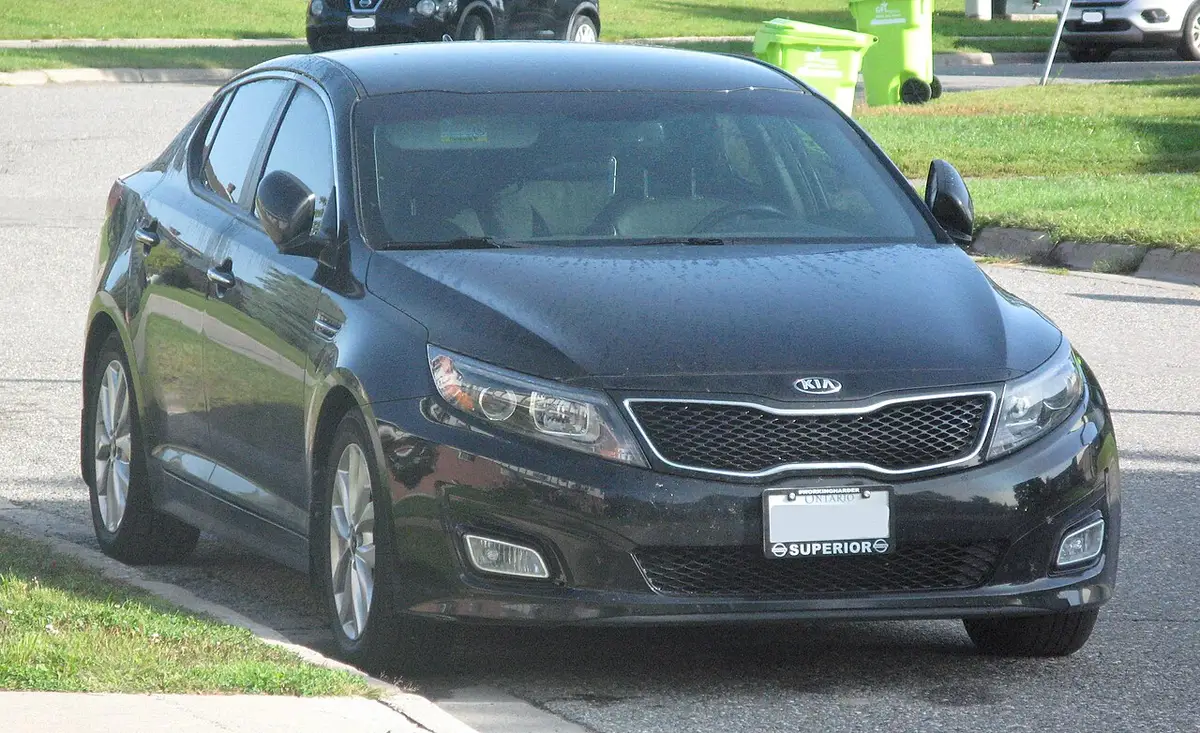
2014 Kia Optima
The most reported problem on the 2014 Kia Optima is engine failure, with 129 complaints, usually around 100,000 miles.
- 546owner complaints
- 7recalls
- 19involved a crash
- 85,000median miles at failure
Newest report Sep 28, 2026 · checked Oct 2, 2026
What is your Optima doing?
Each one opens a sheet built from the owner reports of that problem on the 2014 model year.
Is the 2014 Kia Optima reliable?
The 2014 Kia Optima has 546 owner complaints on file with NHTSA, 1.7 times the median of 318 for 2014 sedans on this site. Of the 7 Optima model years since 2014, it has the 3rd most complaints. Complaint counts rise with sales as well as faults, so read what owners report below before deciding.
At a glance
- Next to other model years
- Complaints filed before 2015 aren't in the files this site reads, so the 2014 count runs short and isn't compared with the model years next to it.
- Top problem
- Two problems run close. Engine failure has 129 complaints and stalling has 113, out of 546 in all. It's a high-mileage complaint: half of the 87 owners who gave a mileage for engine failure were past about 100,000 miles.
- Crash, fire and injury reports
- 60 of the 546 complaints (11%) report a crash, a fire or an injury. The typical vehicle on this site sits at 6%, so this one runs well above it. Counted separately (one report can carry more than one), 19 reports mention a crash, 42 mention a fire and 22 people were hurt. The reports record 2 deaths. The most crash reports, 8 of 19, fall under brake wear.
- Recalls behind the top problems
- engine failure, stalling and misfire all have recalls on the same system, and the same campaigns cover them: 17V-224. A recall on the same system doesn't always cover the failure owners describe, so compare its summary with the complaints.
- When owners filed
- Filings peaked in 2019 at 75 (full calendar years only). In 2025 there were 49. So far in 2026, 30 more have come in. Filings on record start in 2015.
When each problem shows up
Each bar covers the middle half of the mileages owners reported for that problem. A quarter saw it earlier, a quarter later. The tick is the median. Most reported: engine failure, knocking or rod bearing, 129 complaints.
middle half of reports, median tick. The heavier grey bars have 75 or more reports.
Behind you
Around your mileage
Ahead of you
How this compares
546 complaints is 1.8 times the median 2014 model on this site and 1.7 times the median 2014 sedan. Among the 7 Optima model years here it ranks 3rd for complaints. Counts follow sales volume as much as reliability, so a truck that sells 700,000 a year draws more reports than a sedan that sells 200,000.
Service bulletins for the 2014 Kia Optima
Kia filed 268 bulletins and other notices with NHTSA that list the 2014 Kia Optima. 59 of them deal with a problem owners have reported on this car. Newest first.
Federal rules make a manufacturer send NHTSA a copy of any notice about a defect that goes to more than one dealer or owner. Most of these are service bulletins, the repair instructions manufacturers send to dealers. NHTSA generally leaves safety recall bulletins out of this file, and recalls are listed separately.
Engine failure, knocking or rod bearing 5 bulletins · 129 complaints
PITSTOP: INJECTOR HARNESS ROUTING FOR PI1802Y/Z AND PI1803Y/Z ENGINE REPLACEMENTS This bulletin provides information to address a no-start or hard start with poor running condition after engine replacement under PI1802Y/Z or PI1803Y/Z. Some replacement long blocks may come with pre-installed fuel rail, injectors, and injector wiring ...
TSB_R7 ENGINE REPLACEMENT INSTRUCTIONS FOR DTC P1326 (PI1802W/X) - CLOSED - SUPERSEDED BY PI1802Y/Z.
3 more on this problem
TSB - ENGINE REPLACEMENT INSTRUCTIONS FOR DTC P1326 (PI1803W/X) CLOSED - This bulletin has been superseded by PI1803Y/Z.
VEHICLE PRODUCT IMPROVEMENT: ENGINE REPLACEMENT INSTRUCTIONS FOR DTC P1326 (PI1802W/X) Specifically, this bulletin provides instructions on which procedures to follow if, after installation of the KSDS, any one of the subject vehicles below returns to the dealer with Diagnostic Trouble Code (?DTC?), P1326..
VEHICLE PRODUCT IMPROVEMENT: ENGINE REPLACEMENT INSTRUCTIONS FOR DTC P1326 (PI1803W/X) Specifically, this bulletin provides instructions on which procedures to follow if, after installation of the KSDS, any one of the subject vehicles below returns to the dealer with Diagnostic Trouble Code (?DTC?), P1326.
Check engine light or misfire 8 bulletins · 53 complaints
COMBINATION TSB / SERVICE ACTION: AIR FILTER AND NVLD REPLACEMENT (SA447) This bulletin provides the procedure to perform an evaporative leak test and replace the Fuel Tank Air Filter, and, if necessary, the Natural Vacuum Leak Detector (NVLD) on some 11-16MY Kia vehicles listed in the table below, which may experience an ...
PITSTOP: MANUAL EVAPORATIVE EMISSIONS TEST FOR HARD TO FIND/SMALL LEAKS If the malfunction indicator lamp (MIL) is illuminated with DTC(s) P0442, P0455, P0456, or P0457 (Evaporative Emissions System-Leak detected) and the evaporative (EVAP) leak self-test resulted in NTF, a manual EVAP test is recommended.
6 more on this problem
ECU UPGRADE ? MIL ON WITH DTC(s) P0420/P0171 - This bulletin provides information related to the ECU software upgrade for some 2012~2015MY Optima (QF) vehicles, produced from August 12, 2011 to October 2, 2015, some 2012~2015MY Sorento (XMa) vehicles, ...
2.4 GDI MIL ON WITH DTC(S) P0263/ P0266/ P0269/ P0272 THIS BULLETIN PROVIDES INFORMATION ABOUT THE REPLACEMENT OF THE FUEL INJECTORS IN SOME SORENTO (XMA) PRODUCED 12/17/2012~12/11/2014, OPTIMA (QF) PRODUCED 07/28/2013~10/02/2015, OPTIMA (TF) PRODUCED 09/09/2013~07/23/2015 2014~2015MY, AND SPORTAGE (SL) PRODUCED ...
KIA: CRANKSHAFT POSITION SENSOR (CKP) VARIATION HAS NOT LEARNED CAUSING MISFIRE OF ENGINE AND MALFUNCTION INDICATOR LIGHT (MIL) TO COME IN DASH. MODEL ALL. NO YEARS LISTED. *PE
PITSTOP: RESETTING CYLINDER BALANCE ADAPTATION VALUES When addressing a cylinder balance concern on a vehicle equipped with a 2.4L GDI engine, it is important to note that the DTC may recur after replacement of any faulty component(s) and resetting adaptive values.
6 SPD A/T SOLENOID REPLACEMENT ? DTC P0741 This bulletin provides information relating to the replacement of the Damper Clutch (D/C) Solenoid on 6-speed automatic transaxles with DTC P0741 (active or history), instead of replacing the transaxle.
PIT STOP: DTC P0456 AND CHARCOAL CANISTER LEAKS When addressing a concern related to a DTC P0456 (Evaporative Emissions System ? Small Leak Detected), and an inspection of the vapor lines, connections and fuel cap reveal no abnormalities, closely inspect the mounting holes of the charcoal canister for ...
Engine knocking or ticking 30 bulletins · 51 complaints
PRODUCT IMPROVEMENT CAMPAIGN: ENGINE REPLACEMENT INSTRUCTIONS FOR DTC P1326 (PI1802Y/Z) This bulletin provides information related to the Technical Service Bulletin previously published PI1802 titled "Knock Sensor Detection System - ECU Logic Improvement"; equipped w/THETA II engine.
PRODUCT IMPROVEMENT CAMPAIGN: ENGINE REPLACEMENT INSTRUCTIONS FOR DTC P1326 (PI1803Y/Z) This bulletin provides information related to the Technical Service Bulletin previously published PI1803 titled "Knock Sensor Detection System - ECU Logic Improvement" equipped w/THETA II engine.
28 more on this problem
ENGINE REPLACEMENT INSTRUCTIONS FOR DTC P1326 (PI1802Y/Z) This bulletin provides information related to the Technical Service Bulletin previously published PI1802 titled "Knock Sensor Detection System - ECU Logic Improvement" equipped w/THETA II engine.
ENGINE REPLACEMENT INSTRUCTIONS FOR DTC P1326 (PI1803Y/Z) This bulletin provides information related to the Technical Service Bulletin previously published PI1803 titled "Knock Sensor Detection System - ECU Logic Improvement" equipped w/THETA II engine.
TECHNICAL SERVICE BULLETIN PRODUCT IMPROVEMENT CAMPAIGN PI1803_TSB_R6: KNOCK SENSOR DETECTION SYSTEM - ECU - LOGIC IMPROVEMENT (PI1803) - This bulletin provides information related to a software update to the Engine Control Unit (ECU) to install the Knock Sensor Detection System (KSDS) ...
PRODUCT IMPROVEMENT TSB_PI1802_R2 - Knock Sensor Detection System - ECU Logic Improvement - This bulletin provides information related to a software update to the Engine Control Unit (ECU) to install the Knock Sensor Detection System (KSDS) in order to protect the engine from ...
PRODUCT IMPROVEMENT CAMPAIGN ENGINE REPLACEMENT INSTRUCTIONS FOR DTC P1326 (PI1803Y/Z_Rev3) - This bulletin provides information related to the Technical Service Bulletin previously published in July 2018 (PI1803, Rev 10, 03/16/2020) titled "Knock Sensor Detection System - ECU Logic ...
PRODUCT IMPROVEMENT CAMPAIGN ENGINE REPLACEMENT INSTRUCTIONS FOR DTC P1326 (PI1802Y/Z_Rev3) - - This bulletin provides information related to the Technical Service Bulletin previously published in July 2018 (PI1802 Rev 10, 03/16/2020) titled "Knock Sensor Detection System - ECU Logic ...
PRODUCT IMPROVEMENT CAMPAIGN ENGINE REPLACEMENT INSTRUCTIONS FOR DTC P1326 (PI1802Y/Z_Rev2) - This bulletin provides information related to the Technical Service Bulletin previously published in July 2018 (PI1802 Rev 10, 03/16/2020) titled "Knock Sensor Detection System - ECU Logic ...
PRODUCT IMPROVEMENT CAMPAIGN : KNOCK SENSOR DETECTION SYSTEM (KSDS) LOGIC IMPROVEMENT (PI1802_R11) This bulletin provides information related to a software update to the Engine Control Unit (ECU) to install the Knock Sensor Detection System (KSDS) in order to protect the engine from excessive connecting rod bearing damage.
TSB - ENGINE REPLACEMENT INSTRUCTIONS FOR DTC P1326 (PI1803Y/Z) This bulletin provides information related to the Technical Service Bulletin previously published in July 2018 (PI1803, Rev 10, 03/16/2020) titled "Knock Sensor Detection System - ECU Logic Improvement".
TSB - ENGINE REPLACEMENT INSTRUCTIONS FOR DTC P1326 (PI1802Y/Z) This bulletin provides information related to the Technical Service Bulletin previously published in July 2018 (PI1802 Rev 10, 03/16/2020) titled Knock Sensor Detection System - ECU Logic Improvement.
Plus 18 older ones not listed here.
Paint peels or body rusts 3 bulletins · 33 complaints
SC141 - SERVICE CAMPAIGN APPLICATION OF ADDITIONAL ANTI-CORROSION MATERIAL - To improve customer satisfaction, Kia is launching this service campaign to apply additional anti-corrosion material to the underbody components of certain 2011-2014MY Sorento, 2011-2014MY Optima and Optima ...
SERVICE MANAGER MEMO: SC141 SERVICE CAMPAIGN - Attention: All Kia Service Managers - Kia Motors America, Inc. will be conducting a Voluntary Service Campaign, as a preventative measure, to apply additional anti-corrosion material to the underbody components of certain 2011-2014 MY ...
1 more on this problem
QUESTIONS AND ANSWERS FOR VOLUNTARY SERVICE CAMPAIGN SC141 ? UNDERBODY ? ADDITIONAL ANTI-CORROSION TREATMENT
Steering wheel clicks, clunks or grinds when I turn 7 bulletins · 23 complaints
PARTIAL REPAIR OF C-MDPS MOTOR, ECU, WORM GEAR AND/OR STEERING COLUMN HOUSING This bulletin provides information regarding the partial repair of the Motor Driven Power Steering (MDPS) Motor, Electronic Control Unit (ECU), Steering Column Housing, or Worm Gear Assembly.
STEERING GEAR YOKE PLUG AND ASSEMBLY REPLACEMENT This bulletin provides the procedure to replace the steering gear box yoke plug and assembly on some models listed below, which may exhibit a ticking noise while turning the steering wheel with the vehicle stopped.
5 more on this problem
MDPS FLEXIBLE COUPLING REPLACEMENT CUSTOMER SATISFACTION PROGRAM (CS1604) This bulletin provides information regarding the replacement of the flexible coupling in the Motor Driven Power Steering (MDPS) on some 2011-2014 MY Optima (QF/TF/TFH) vehicles, produced from August 12, 2010 to December 18, 2013.
TSB REV1: MDPS FLEXIBLE COUPLING REPLACEMENT CUSTOMER SATISFACTION PROGRAM (CS1604) THIS BULLETIN PROVIDES INFORMATION REGARDING THE REPLACEMENT OF THE FLEXIBLE COUPLING IN THE MOTOR DRIVEN POWER STEERING (MDPS) ON SOME 2011-2014 MY OPTIMA (QF/TF/TFH) VEHICLES, PRODUCED FROM AUGUST 12, 2010 TO DECEMBER 18, 2013.
DEALER PARTS AND SERVICE MANAGER MEMO: CS1604 KIA MOTORS AMERICA, INC. IS CONDUCTING A CUSTOMER SATISFACTION / WARRANTY EXTENSION PROGRAM REGARDING THE MOTOR DRIVEN POWER STEERING (MDPS) ON ALL 2011-2013 MY AND SOME 2014 MY KIA OPTIMA VEHICLES.
MDPS FLEXIBLE COUPLING REPLACEMENT Rev 2 - This bulletin provides information related to the replacement of the flexible coupling in the MDPS motor of some of vehicles, which may experience a ?clicking? noise emanating from the MDPS when turning the steering wheel left or right, while stopped.
MDPS FLEXIBLE COUPLING REPLACEMENT This bulletin provides information related to the replacement of the flexible coupling in the MDPS motor of some of vehicles, which may experience a ?clicking? noise emanating from the MDPS when turning the steering wheel left or right, while stopped.
Hybrid or EV system warning, loss of power 1 bulletin · 18 complaints
UVO SOFTWARE UPGRADE MEDIA BUTTON INOPERATIVE - THIS BULLETIN PROVIDES THE PROCEDURE FOR UPGRADING THE UVO SYSTEM OF SOME 2014~2015MY SPORTAGE (SL), FORTE (YD), OPTIMA (TF/QF), OPTIMA HYBRID (TF HEV) AND SORENTO (XMA) VEHICLES, WHICH MAY EXHIBIT AN INOPERATIVE UVO MEDIA BUTTON.
Power steering cuts out or goes heavy 1 bulletin · 13 complaints
SERVICE ACTION: STEERING FEEL IMPROVEMENT (SA188) THIS BULLETIN PROVIDES INFORMATION RELATED TO AN UPGRADE OF THE LOGIC FOR THE MOTOR DRIVEN POWER STEERING (MPDS) ECU OF SOME 2014~2015MY OPTIMA (QF) VEHICLES, PRODUCED FROM AUGUST 23, 2013 THROUGH JULY 24, 2014, TO ADDRESS SOME COMPLAINTS THAT THE STEERING ...
Burns oil or oil level rises 4 bulletins · 13 complaints
EXCESSIVE OIL CONSUMPTION NU/GAMMA/THETA/KAPPA ENGINES This bulletin provides information on diagnosing and/or repairing some 2011-2024MY vehicles (refer to the table on pages 9 and 10 for applicable models and engine), which may exhibit a symptom of excessive oil consumption.
EXCESSIVE OIL CONSUMPTION NU/GAMMA/THETA/KAPPA ENGINES This bulletin provides information on diagnosing and/or repairing some 2011-2021MY vehicles (refer to the tables on pages 8-9 for applicable models and engine), which may exhibit a symptom of excessive oil consumption.
2 more on this problem
EXCESSIVE OIL CONSUMPTION NU/GAMMA/THETA/KAPPA ENGINES This bulletin provides information on diagnosing and/or repairing some 2011-2019MY vehicles (refer to table below for applicable model and engine), which may exhibit a symptom of excessive oil consumption.
EXCESSIVE OIL CONSUMPTION NU/GAMMA/THETA ENGINES This bulletin provides information on diagnosing and/or repairing some 2011-2019MY vehicles (refer to table below for applicable model and engine), which may exhibit a symptom of excessive oil consumption.
Complaints filed by year
75 complaints came in 2019. Owners file in waves when a problem gets press or an investigation, so a spike measures attention as much as failures.
NHTSA investigations
Hyundai and kia abs module fires. Open.
NHTSA summary
Loss of motive power. Closed dec 12, 2023.
NHTSA summary
Engine fires. Closed feb 5, 2024, led to recall 23V-877.
NHTSA summary
Throttle control system vulnerabilities. Closed jun 20, 2023.
NHTSA summary
Electrical overstress. Closed sep 19, 2024, led to recall 20V-024.
NHTSA summary
Non-crash vehicle fires. Closed dec 22, 2021, led to recall 20V-088.
NHTSA summary
Non-crash vehicle fires. Closed may 10, 2019, led to recall 18V-907.
NHTSA summary
Scope and timeliness. Closed dec 22, 2021, led to recall 17V-224.
NHTSA summary
Recalls that include the 2014 Kia Optima
Whether your car is included depends on its VIN. Check yours at nhtsa.gov/recalls.
Kia America, Inc. (Kia) is recalling certain 2010-2019 Borrego, 2014-2016 Cadenza, 2010-2013 Forte, Forte Koup, Sportage, 2015-2018 K900, 2011-2015 Optima, 2011-2013 Optima Hybrid, Soul, 2012-2017 Rio, 2011-2014 Sorento, and 2010-2011 Rondo vehicles. The Hydraulic Electronic Control Unit (HECU) may experience an electrical short, which can result in an engine compartment fire while parked or driving.
Risk and remedy
Remedy: Owners are advised to park outside and away from structures until the recall repair is complete. Dealers will replace the HECU fuse, free of charge. Interim notification letters, notifying owners of the safety risk, were mailed November 14, 2023. Owner notification letters were mailed March 29, 2024 through June 18, 2024. Owners may contact Kia customer service at 1-800-333-4542. Kia's number for this recall is SC284.
Kia Motors America (Kia) is recalling certain 2013-2014 Optima vehicles that were previously repaired under NHTSA recall number 20V-100. The low pressure fuel hose may be damaged, or missing heat-protective tape, which can result in a fuel leak.
Risk and remedy
Remedy: Dealers will replace the low pressure fuel hose, free of charge. Owner notification letters were mailed August 2, 2022. Owners may contact Kia customer service at 1-800-33-4542. Kia's number for this recall is SC228.
Kia Motors America (Kia) is recalling certain 2013-2015 Optima and 2014-2015 Sorento vehicles previously recalled under recall 20V-519. Brake fluid may leak inside the Hydraulic Electronic Control Unit (HECU), possibly resulting in an electrical short.
Risk and remedy
Remedy: Owners are advised to park outside and away from other vehicles and structures until the recall repair is completed. Dealers will install a new multi-fuse, and inspect the HECU for leaks, replacing the HECU if necessary, free of charge. Owner notification letters were mailed on July 2, 2021. This recall supersedes previous NHTSA recall number 20V-519. Owners may contact Kia customer service at 1-800-333-4542. Kia's number for this recall is SC212.
Kia Motors America (Kia) is recalling certain 2013-2015 Optima and 2014-2015 Sorento vehicles. Brake fluid may leak inside the Hydraulic Electronic Control Unit (HECU), possibly resulting in an electrical short.
Risk and remedy
Remedy: Kia will notify owners, and dealers will inspect the HECU for leaking brake fluid and replace the HECU if necessary, free of charge. Owners are advised to park outside and away from other vehicles and structures until the recall repair is completed. The recall began October 20, 2020. Owners may contact Kia customer service at 1-800-333-4542. Kia's number for this recall is SC197.
Kia Motors America (Kia) is recalling certain 2013-2014 Optima vehicles equipped with 2.4L Gasoline Direct Injection (GDI) or 2.0L GDI Turbo engines. The low pressure fuel hose may deteriorate and crack over time due to heat generated within the engine compartment.
Risk and remedy
Remedy: Kia will notify Owners, and Dealers will inspect the low pressure fuel hose for damage or leaking, replacing it as necessary. If no damage or leaking is found, a heat-protective tape will be installed. Repairs will be performed free of charge. The recall began June 12, 2020. Owners may contact Kia customer service at 1-800-333-4542. Kia's number for this recall is SC187.
Kia Motors America (Kia) is recalling certain 2011-2017 Optima, 2012-2017 Sorento and 2011-2018 Sportage vehicles that previously received an engine replacement under recall number 17V-224, warranty, or the Knock Sensor Detection System (KSDS) Product Improvement Campaign. The high pressure fuel pipe that connects to the fuel pump outlet may have been damaged, misaligned or improperly torqued during the engine replacement procedure, possibly causing a fuel leak.
Risk and remedy
Remedy: Kia has notified owners, and dealers will inspect and replace the fuel pipe, as necessary, free of charge. The recall began January 17, 2019. Owners may contact Kia customer service at 1-800-333-4542. Kia's number for this recall is SC172.
Kia Motor Company (Kia) is recalling certain 2011-2014 Optima, 2012-2014 Sorento and 2011-2013 Sportage vehicles. Machining errors during the engine manufacturing process may cause premature bearing wear within the engine.
Risk and remedy
Remedy: Kia will notify owners, and dealers will inspect the engine assembly, and replace the engine if necessary, free of charge. The recall began June 20, 2017. Owners may contact Kia customer service at 1-800-333-4542. Kia's number for this recall is SC147.
All 7 recalls on the 2014 Kia Optima, with the owner complaints on each recalled system
Guide NHTSA has an open investigation on this car. What the investigation stages mean
Questions
What is the most common problem on the 2014 Kia Optima?
Engine failure, with 129 of the 546 complaints. Owners who gave a mileage for it put the median at about 100,000 miles.
At what mileage do 2014 Kia Optima problems start?
Of the 309 complaints that give a mileage, a quarter came by about 51,000 miles and half by about 85,000.
How many 2014 Kia Optima complaints involve a crash, fire or injury?
60 of them (11%). The typical vehicle on this site is at 6%.
Is there a recall for engine failure on the 2014 Kia Optima?
Yes, NHTSA lists a recall on the same system: 17V-224. Its summary says which failure it covers, and that isn't always the one owners describe.