Fifth generation (L33)
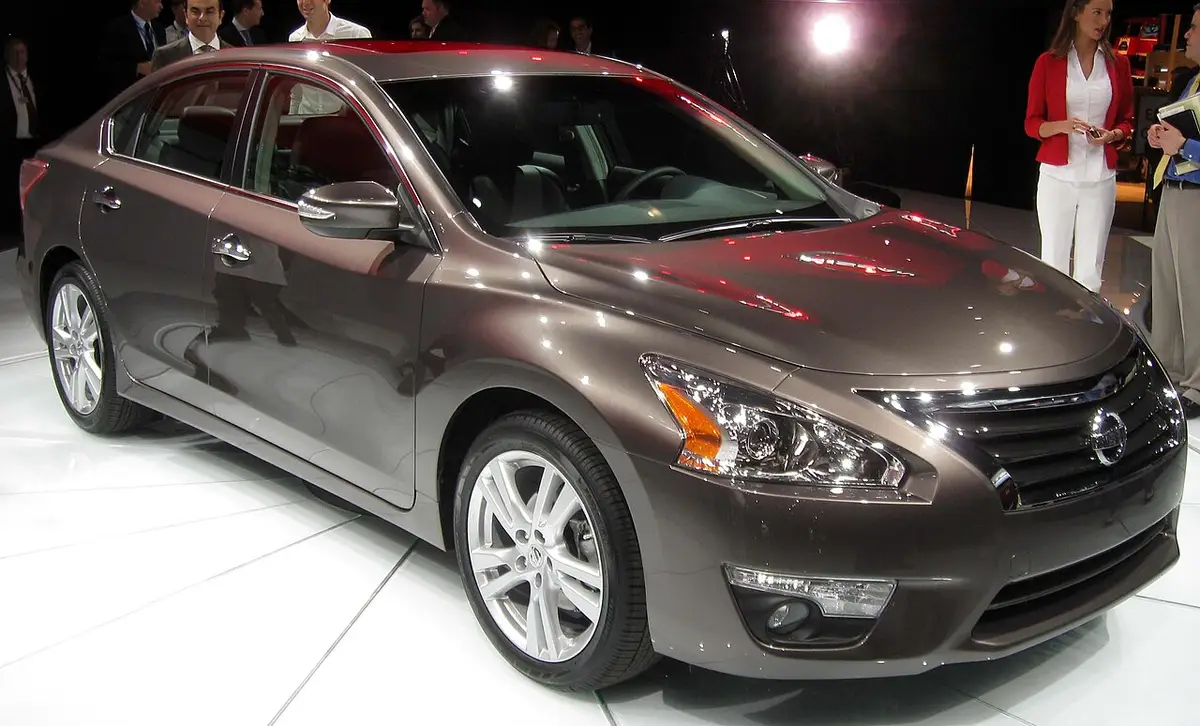
2018 Nissan Altima
The most reported problem on the 2018 Nissan Altima is brake wear, with 49 complaints, usually around 34,000 miles.
- 225owner complaints
- 2recalls
- 11involved a crash
- 40,000median miles at failure
Newest report Aug 25, 2026 · checked Oct 2, 2026
What is your Altima doing?
Each one opens a sheet built from the owner reports of that problem on the 2018 model year.
Is the 2018 Nissan Altima reliable?
The 2018 Nissan Altima has 225 owner complaints on file with NHTSA, 1.3 times the median of 177 for 2018 sedans on this site. Of the 11 Altima model years since 2014, it has the 6th most complaints. Complaint counts rise with sales as well as faults, so read what owners report below before deciding.
At a glance
- Next to the 2017 and 2019
- At 25 complaints for each year on the road, the 2018 runs below both the 2017 (39) and the 2019 (29).
- Top problem
- Brake wear leads with 49 of the 225 complaints (22%), ahead of airbag at 36. A quarter of the 39 owners who gave a mileage for brake wear saw it by about 15,000 miles, and half by about 34,000.
- Crash, fire and injury reports
- 12 of the 225 complaints (5%) report a crash, a fire or an injury, about the 6% typical of vehicles on this site. Counted separately (one report can carry more than one), 11 reports mention a crash and 6 people were hurt. The most crash reports, 4 of 11, fall under brake wear.
- Recalls behind the top problems
- No recall on file is on the same system as brake wear and airbag. For those, the complaints are all there is.
- When owners filed
- Filings peaked in 2019 at 57 (full calendar years only). In 2025 there were 18. So far in 2026, 12 more have come in.
When each problem shows up
Each bar covers the middle half of the mileages owners reported for that problem. A quarter saw it earlier, a quarter later. The tick is the median. Most reported: brakes grind, pulse or wear early, 49 complaints.
middle half of reports, median tick. The heavier grey bars have 75 or more reports.
Behind you
Around your mileage
Ahead of you
How this compares
225 complaints is 1.2 times fewer than the median 2018 model on this site and 1.3 times the median 2018 sedan. Among the 9 Altima model years here it ranks 6th for complaints. Counts follow sales volume as much as reliability, so a truck that sells 700,000 a year draws more reports than a sedan that sells 200,000.
Service bulletins for the 2018 Nissan Altima
Nissan filed 192 bulletins and other notices with NHTSA that list the 2018 Nissan Altima. 18 of them deal with a problem owners have reported on this car. Newest first.
Federal rules make a manufacturer send NHTSA a copy of any notice about a defect that goes to more than one dealer or owner. Most of these are service bulletins, the repair instructions manufacturers send to dealers. NHTSA generally leaves safety recall bulletins out of this file, and recalls are listed separately.
Airbag warning light or recall 1 bulletin · 36 complaints
DTC B00A0-00 STORED
Airbag warning light stays on 1 bulletin · 21 complaints
AIR BAG WARNING LIGHT FLASHING INDICATING SYSTEM DIAGNOSTIC MODE IF YOU CONFIRM The air bag warning light is flashing slowly (repeating 2 seconds ON, 2 seconds OFF). NOTE: If this should occur, the Air Bag Diagnosis Sensor Unit is in Diagnostic Mode and needs to be returned to User Mode. ACTION 1.
Infotainment, screen or backup camera fails 6 bulletins · 14 complaints
INTELLIGENT CRUISE CONTROL INOPERATIVE AND AEB/FEB WARNING LIGHT ON OR RADAR OBSTRUCTION MESSAGE DISPLAYED WITH DTC C1A16 OR C2582 IF YOU CONFIRM IMPORTANT: The purpose of ACTION (on the next page) is to give you a quick idea of the work you will be performing. You MUST closely follow the entire SERVICE PROCEDURE as it contains information that is essential to successfully completing this repair.
NAVIGATION SYMPTOMS WHEN SD CARD IS MISSING OR WRONG CARD INSTALLED
4 more on this problem
DTC B00A0-00 STORED IF YOU CONFIRM DTC B00A0-00 (OCCUPANT DETECTION SENSOR UNIT) is stored And OCS zero point reset cannot be performed And The following screen displays: ACTION 1.
NAVIGATION SYMPTOMS WHEN SD CARD IS MISSING OR WRONG CARD INSTALLED The tables on page 5 and 6 have been revised. No other changes have been made.
NISSAN; MICROPHONE DOES NOT WORK This bulletin applies only to vehicles equipped with Telematics. IF YOU CONFIRM The microphone of an applied vehicle does not work. - The person receiving your call through Bluetooth® cannot hear you. And Voice Recognition does not respond to any commands.
NAVIGATION SYMPTOMS WHEN SD CARD IS MISSING OR WRONG CARD INSTALLED The Applied Vehicles section has been revised, and changes have been made to the table beginning on page 5. No other changes have been made.
Transmission shudders, slips or shifts hard 1 bulletin · 8 complaints
PATHFINDER, ALTIMA, MAXIMA, MURANO AND QUEST; CVT JUDDER AND DTC P17F0 OR P17F1 STORED IF YOU CONFIRM The customer reports a transmission judder (shake, shudder, single or multiple bumps or vibration), AND One of these DTCs is stored: ï· P17F0 (CVT_JUDDER (T/M INSPECTION)) ï· P17F1 (CVT_JUDDER (C/U INSPECTION)) NOTE: ï If a transmission judder (as ...
Headlights too dim or fail 4 bulletins · 8 complaints
Halogen Headlamp Warranty Extension REVISED September 27, 2022 Please discard earlier versions of this bulletin. The announcement from April 12, 2022 has been revised to include the following: ⢠The claims information section has been updated with parts ...
VOLUNTARY SERVICE CAMPAIGN 2013-2018 ALTIMA SEDAN; FRONT COMBINATION LAMPS (HEADLAMPS) INSPECTION Voluntary Service Campaign ID # PC861 is no longer active. ï· Repair orders opened after this bulletinâs published date are no longer eligible for reimbursement under Campaign ID # PC861. ï· Discard all previous versions of NTB22-024.
2 more on this problem
Halogen Headlamp Warranty Extension REVISED February 23, 2022 Please discard earlier versions of this bulletin. The announcement from January 25, 2022 has been revised to include the following: ⢠If a customer requests inspection due to a visibility ...
2013-2018 ALTIMA; FRONT COMBINATION LAMPS (HEADLAMPS) INSPECTION SERVICE INFORMATION Nissan is committed to providing the highest levels of product quality and customer satisfaction. Therefore, Nissan will provide a three-year extension of the manufacturerâs warranty (for a total of six years) covering headlamp dimming due to delamination.
Seat belt or seat problems 2 bulletins · 6 complaints
DRIVERS POWER SEAT IS INOPERATIVE IF YOU CONFIRM The customer states that one or more of the driver (LH) seat controls are (or were) inoperative, AND/OR The windows, sunroof, sunshade and power mirrors are (or were) inoperative. NOTE: A no start condition may also be present.
VOLUNTARY SERVICE CAMPAIGN 2018 ALTIMA; FRONT PASSENGER SEATBACK INTRODUCTION Nissan is conducting this voluntary service campaign on certain specific model year 2018 Altima vehicles to replace the front passenger seatback assembly. This service will be performed at no charge to the customer for parts or labor.
Engine stalls or loses power while driving 2 bulletins · 5 complaints
2018 ALTIMA AND 2018-2019 ROGUE; DTC P17F0, P17F1, P0776, P2813, P1715, AND/OR P0841 STORED IF YOU CONFIRM One or more of the following DTCs are stored: P0776, P2813, P0841, P17F0, P17F1, P1715 HINT: ï· If DTCs other than those listed above are stored, this bulletin does not apply.
2018 ALTIMA AND ROGUE; DTC P17F0, P17F1, P0776, P2813, P1715, AND/OR P0841 STORED IF YOU CONFIRM One or more of the following DTCs are stored: P0776, P2813, P0841, P17F0, P17F1, P1715 HINT: ï· - If DTCs other than those listed above are stored, this bulletin does not apply.
Passenger airbag sensor problems 1 bulletin · 5 complaints
DTC B00A0-00 STORED IF YOU CONFIRM DTC B00A0-00 (OCCUPANT DETECTION SENSOR UNIT) is stored, AND OCS zero point reset cannot be performed,
Complaints filed by year
57 complaints came in 2019, 9.5 times the year before. Owners file in waves when a problem gets press or an investigation, so a spike measures attention as much as failures.
NHTSA investigations
Hertz/vehicles rented with open recalls. Open.
NHTSA summary
Desiccated air bag inflator rupture. Open.
NHTSA summary
Rear suspension control arm failure. Closed jun 16, 2025.
NHTSA summary
Rear suspension control arm failure. Closed aug 21, 2019.
NHTSA summary
Recalls that include the 2018 Nissan Altima
Whether your car is included depends on its VIN. Check yours at nhtsa.gov/recalls.
Nissan North America, Inc. (Nissan) is recalling certain model year 2013-2018 Nissan Altima vehicles. If the primary hood latch is inadvertently released, there is an increased likelihood that the secondary hood latch may corrode over time.
Risk and remedy
Remedy: Nissan will notify owners, and dealers will install a stronger release spring in the hood release lever, a warning label near the secondary hood latch, and an Owners Manual addendum card with instructions on how to lubricate and maintain the secondary hood latch mechanism, free of charge. Owner notification letters were mailed June 30, 2021. Owners may contact Nissan customer service at 1-800-867-7669. Note: Recall 16V-029 remains open for any unremedied 2013-2015 Altimas and this recall applies to all vehicles covered by 16V-029 even if those repairs have already been performed.
Nissan North America, Inc. (Nissan) is recalling certain 2018-2019 Nissan Altima, Armada, Frontier, Kicks, Leaf, Maxima, Murano, NV, NV200, Pathfinder, Rogue, Rogue Sport, Sentra, Titan, Titan Diesel, Versa Note and Versa Sedan vehicles, as well as Infiniti Q50, Q60, QX30 and QX80 vehicles. Additionally included are 2019 Nissan GT-R and Taxi and Infiniti QX50, QX60, Q70, Q70L vehicles. The back-up camera and display settings can be adjusted such that the rear view image is no longer visible and the system will retain that setting the next time the vehicle is placed in reverse. As such, these vehicles fail to comply with the requirements of Federal Motor Vehicle Safety Standard (FMVSS) number 111, "Rear Visibility."
Risk and remedy
Remedy: Nissan will notify owners in phases, having dealers update the back-up camera settings software, free of charge. The recall began November 11, 2019 and all affected VINs should be activated. Owners may contact Nissan customer service at 1-800-867-7669 or INFINITI customer service at 1-800-662-6200.
All 2 recalls on the 2018 Nissan Altima, with the owner complaints on each recalled system
Guide NHTSA has an open investigation on this car. What the investigation stages mean
Questions
What is the most common problem on the 2018 Nissan Altima?
Brake wear, with 49 of the 225 complaints. Owners who gave a mileage for it put the median at about 34,000 miles.
At what mileage do 2018 Nissan Altima problems start?
Of the 118 complaints that give a mileage, a quarter came by about 19,000 miles and half by about 40,000.
Is the 2018 Nissan Altima better or worse than the 2017 and 2019?
Counted per year on the road, the 2018 has fewer complaints than both the 2017 and the 2019: 25 a year against 39 and 29.
How many 2018 Nissan Altima complaints involve a crash, fire or injury?
12 of them (5%). The typical vehicle on this site is at 6%.
Is there a recall for brake wear on the 2018 Nissan Altima?
No recall on file for the 2018 Nissan Altima is on the same system as brake wear. Another recall may still cover your car, so check its VIN at nhtsa.gov/recalls.