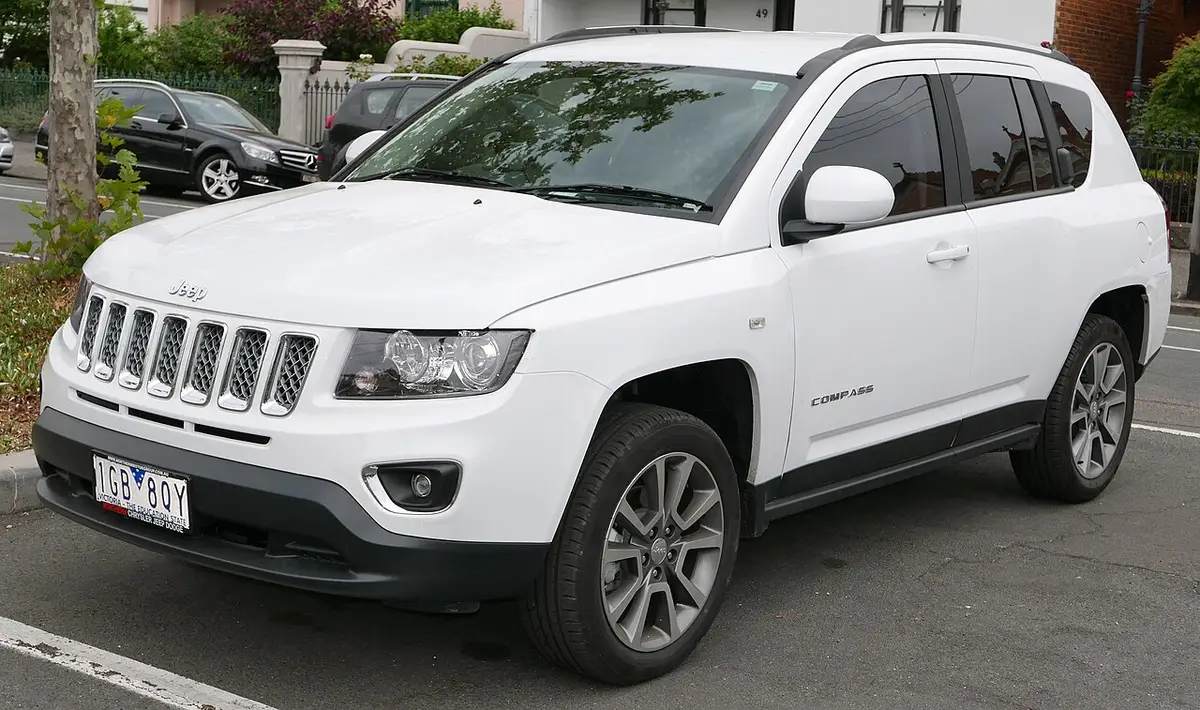
The 2015 Jeep Compass has 113 owner complaints on file with NHTSA, less than half the median of 314 for 2015 SUVs on this site. Of the 12 Compass model years since 2014, it has the 8th most complaints. Complaint counts rise with sales as well as faults, so read what owners report below before deciding.
At a glance
Next to other model years
Complaints filed before 2015 aren't in the files this site reads, so the 2015 count runs short and isn't compared with the model years next to it.
Top problem
Stalling leads with 27 of the 113 complaints (24%), ahead of misfire at 18. A quarter of the 21 owners who gave a mileage for stalling saw it by about 50,000 miles, and half by about 67,000.
Crash, fire and injury reports
10 of the 113 complaints (9%) report a crash, a fire or an injury, a little above the 6% typical of vehicles on this site. Counted separately (one report can carry more than one), 4 reports mention a crash, 2 mention a fire and 7 people were hurt.
Recalls behind the top problems
No recall on file is on the same system as stalling. For those, the complaints are all there is.
When owners filed
Filings peaked in 2019 at 20 (full calendar years only). In 2025 there were 5. So far in 2026, 3 more have come in. Filings on record start in 2015.
When each problem shows up
Each bar covers the middle half of the mileages owners reported for that problem. A quarter saw it earlier, a quarter later. The tick is the median. Most reported: engine stalls or loses power while driving, 27 complaints.
middle half of reports, median tick. The heavier grey bars have 75 or more reports.
Behind you
Around your mileage
Ahead of you
How this compares
2015 Jeep Compass113
Median 2015 model here (104 vehicles)277
Median 2015 SUV here (44)314
113 complaints is 2.5 times fewer than the median 2015 model on this site and 2.8 times fewer than the median 2015 SUV. Among the 8 Compass model years here it ranks 8th for complaints. Counts follow sales volume as much as reliability, so a truck that sells 700,000 a year draws more reports than a sedan that sells 200,000.
Service bulletins for the 2015 Jeep Compass
Jeep filed 176 bulletins and other notices with NHTSA that list the 2015 Jeep Compass. 9 of them deal with a problem owners have reported on this car. Newest first.
Federal rules make a manufacturer send NHTSA a copy of any notice about a defect that goes to more than one dealer or owner. Most of these are service bulletins, the repair instructions manufacturers send to dealers. NHTSA generally leaves safety recall bulletins out of this file, and recalls are listed separately.
Check engine light or misfire 6 bulletins · 18 complaints
Service bulletin1804823Apr 15, 2023
wiTECH Small Leak Verification Test (SLVT) - P0456-EVAP SYSTEM SMALL LEAK
Service bulletin9003694Mar 15, 2017
Oil Pump Assembly If error code P06DD present on any Pentastar V6 application, please inspect oil pump for relief valve failure. See photo attached.
4 more on this problem
Service bulletin09-006-16May 10, 2016
2.0L Or 2.4L Long Block Replacement This bulletin involves replacing the long block due to incorrect machining operation on the cylinder head. The customer may describe the engine is consuming oil.
Service bulletin05149171A$Mar 23, 2016
Oxygen Sensor Before replacing the Upstream (1/1) O2 Sensor on a 2.4L MK due to a P0131 fault code, please contact Vijay Thiruvenkatachary at cell (906) 281-8495.~ Before replacing the Left Downstream (2/2) O2 Sensor on a 3.6L JK due to a P0157 fault code, ...
Service bulletin18-070-14Nov 27, 2014
Flash: MIL Illumination, P219A, P050B And Cold Start Improvements This bulletin involves selectively erasing and reprogramming the Powertrain Control Module (PCM) with new software.
Service bulletin1807014Nov 27, 2014
MIL Illumination, P219A, P050B And Cold Start Improvements
Seat belt or seat problems 1 bulletin · 14 complaints
Service bulletin2302920Nov 6, 2020
Active Head Restraint (AHR) Inadvertent Deployment - X86 Warranty Extension This bulletin involves inspecting the sled bracket striker pin and possibly replacing a front seat AHR that has inadvertently deployed.
Brakes grind, pulse or wear early 2 bulletins · 6 complaints
Service bulletin0500316Aug 20, 2016
Low Frequency Moan Heard During First Brake Apply This bulletin involves installing an anti-vibration bracket to the rear brake caliper.
Service bulletin0500314Dec 20, 2014
Low Frequency Moan Noise Heard During First Brake Apply This bulletin involves installing an anti-vibration bracket to the rear brake caliper.
Complaints filed by year
20 complaints came in 2019. Owners file in waves when a problem gets press or an investigation, so a spike measures attention as much as failures.
Stall from crankshaft\camshaft failure. Closed jun 16, 2025.
NHTSA summary
On December 13, 2016, the National Highway Traffic Safety Administration (NHTSA) received recall 16V-907 from Fiat Chrysler Automobiles (FCA) that identified a safety defect involving crankshaft or camshaft sensor failures on certain 2016 Model Year Dodge Journey, Jeep Compass, and Jeep Patriot vehicles. The failure of the crankshaft or camshaft sensor may lead to a loss of motive power (LOMP) in the recalled vehicles. Following the receipt of recall 16V-907, the Office of Defects Investigation (ODI) received 127 vehicle owner’s questionnaires (VOQ), in which consumers allege experiencing crankshaft or camshaft failures on similar vehicles not included in the recall. On July 22, 2022, this Recall Query was opened to further assess the scope, frequency, and safety consequences of the alleged defect described in the recall. During this investigation, ODI sent two information request (IR) letters to FCA. The first letter was sent on August 15, 2022, and the second on July 12, 2024. Responses to these IR letters, that included manufacturer claim data related to the alleged defect, were received on September 26, 2022, and September 6, 2024, respectively. Analysis of ODI and FCA claim data identified two failure modes relating to intermittent crankshaft and camshaft sensor loss of signal. The first failure mode involves a faulty crankshaft or camshaft electrical connector, as identified in recall 16V-907. The second failure mode involves a faulty crankshaft and/or camsh
From 2000 through 2017, Takata produced millions of air bag inflators using two types of phase-stabilized ammonium nitrate ("PSAN") propellant -- propellant 2004 and propellant 2004L. After prolonged exposure to high temperature cycles and humidity, inflators using propellant 2004 can degrade, causing the propellant to burn too quickly when ignited. The rapid burning can cause the inflator to rupture during deployment, potentially causing serious or even fatal injury to vehicle occupants. See 2016 Blomquist Report at www.nhtsa.gov/sites/nhtsa.gov/files/documents/expert_report-hrblomquist.pdf.Consequently, all frontal inflators using propellant 2004 that do not contain a "desiccant" (a substance that traps and holds moisture) in US vehicles are under recall. These "non-desiccated" inflators either have been or are required to be replaced.In some cases, the remedy part for these recalled inflators was, or will be, an inflator using either propellant 2004 or 2004L that does contain a desiccant. None of these "desiccated" remedy parts (which were installed in older model year vehicles) are currently under recall for a degradation concern. Certain subsets of desiccated PSAN inflators using propellant 2004 for use as original equipment, however, have been recalled for a degradation concern. All Takata inflators produced with propellant 2004L contain desiccant, and none of these desiccated inflators using propellant 2004L are under recall for a degradation concern. There have been n
Active head rest inadvertent deployment. Closed feb 25, 2026.
NHTSA summary
The Office of Defects Investigation (ODI) opened PE19014 on September 9, 2019, to investigate 128 consumer complaints alleging that the Active Head Rest (AHR) inadvertently deployed without the occurrence of a crash or other rear impact event in model year (MY) 2014 Jeep Grand Cherokee and Dodge Durango vehicles.When ODI opened the investigation, ODI was aware of thirteen alleged injuries.A small number of Early Warning Reports identified driver and/or passenger front seat AHR inadvertent deployments without a rear impact event.Reported safety consequences resulting from the AHR deployments include concussions, headaches, soft tissue injuries, disorientation, nausea, vomiting and/or loss of vehicle control as a result of being surprised and distracted by being struck in the head by the inadvertent AHR deployment. On September 24, 2019, ODI sent an Information Request (IR) letter to Fiat Chrysler Automobiles (FCA).ODI requested certain detailed information from FCA related to the following subject vehicles: MY 2010-2014 Dodge Avenger 200, MY 2010-2014 Dodge Calber, MY 2010-2014 Chrysler Sebring, MY 2013-2015 Ram Tradesman, MY 2012 Ram Van, MY 2010-2019 Dodge Grand Caravan, MY 2010-2016 Chrysler Town and Country, MY 2010-2017 Jeep Compass, MY 2011-2020 Dodge Durango, MY 2011-2020 Jeep Grand Cherokee, MY 2010-2019 Dodge Journey, MY 2010-2012 Jeep Liberty, MY 2010-2011 Jeep Nitro, and MY 2010-2011 Jeep Patriot vehicles.On December 2, 2019, ODI received a response from FCA that in
Electrical overstress. Closed sep 19, 2024, led to recall 20V-024.
NHTSA summary
The Office of Defects Investigation (ODI) opened this investigation to determine if the failure of airbags to deploy during severe crashes, in certain vehicles, was the result of a safety related defect. During the investigation a complex failure was studied that can result in non-deployment of subject vehicle air bags and other restraint system devices in severe crash events. The subject vehicles may be equipped with an airbag control unit (ACU) for the supplemental restraint system (SRS) Electronic Control Unit (ECU) manufactured by ZF-TRW. The ECU receives signals from crash sensors mounted in the vehicle and deploys the vehicle air bags and seat belt pretensioners in accordance with manufacturer design specifications. The ECU in the subject vehicles contains a model DS84 application-specific integrated circuit (ASIC) which controls the communication of the crash sensor signal, firing commands (i.e., when to deploy the airbag(s) and/or pretensioners), and fault information (e.g., diagnostic trouble codes). In September 2016, FCA announced recall 16V-668 for certain model year (MY) 2010 to 2014 Chrysler, Dodge and Jeep products manufactured with the subject ZF-TRW ACU. In this recall, FCA discussed an EOS condition that resulted in a failure of the subject DS84 ASIC, which caused air bag non-deployment. FCA noted that the defect condition had only been observed in vehicles equipped with sensor harnessing routed across the front of the vehicle. Other FCA vehicles
Steering:Hydraulic Power Assist:Hose, Piping, And Connections
Chrysler (FCA US LLC) is recalling certain model year 2015 Jeep Compass and Patriot vehicles manufactured January 1, 2015, to May 11, 2015. During assembly, the power steering hose retention clamp may have been installed at an incorrect location, resulting in the detachment of the low pressure return hose.
Risk and remedy
Risk: If the power steering fluid return hose detaches, it would leak fluid and increase the risk of a fire. Remedy: Chrysler will notify owners, and dealers will inspect the return power steering hose clamp, repositioning the clamp as necessary, free of charge. The recall began on February 5, 2016. Owners may contact Chrysler customer service at 1-800-853-1403. Chrysler's number for this recall is R68.
What is the most common problem on the 2015 Jeep Compass?
Stalling, with 27 of the 113 complaints. Owners who gave a mileage for it put the median at about 67,000 miles.
At what mileage do 2015 Jeep Compass problems start?
Of the 73 complaints that give a mileage, a quarter came by about 47,000 miles and half by about 66,000.
How many 2015 Jeep Compass complaints involve a crash, fire or injury?
10 of them (9%). The typical vehicle on this site is at 6%.
Is there a recall for stalling on the 2015 Jeep Compass?
No recall on file for the 2015 Jeep Compass is on the same system as stalling. Another recall may still cover your car, so check its VIN at nhtsa.gov/recalls.