Eleventh generation (E170)
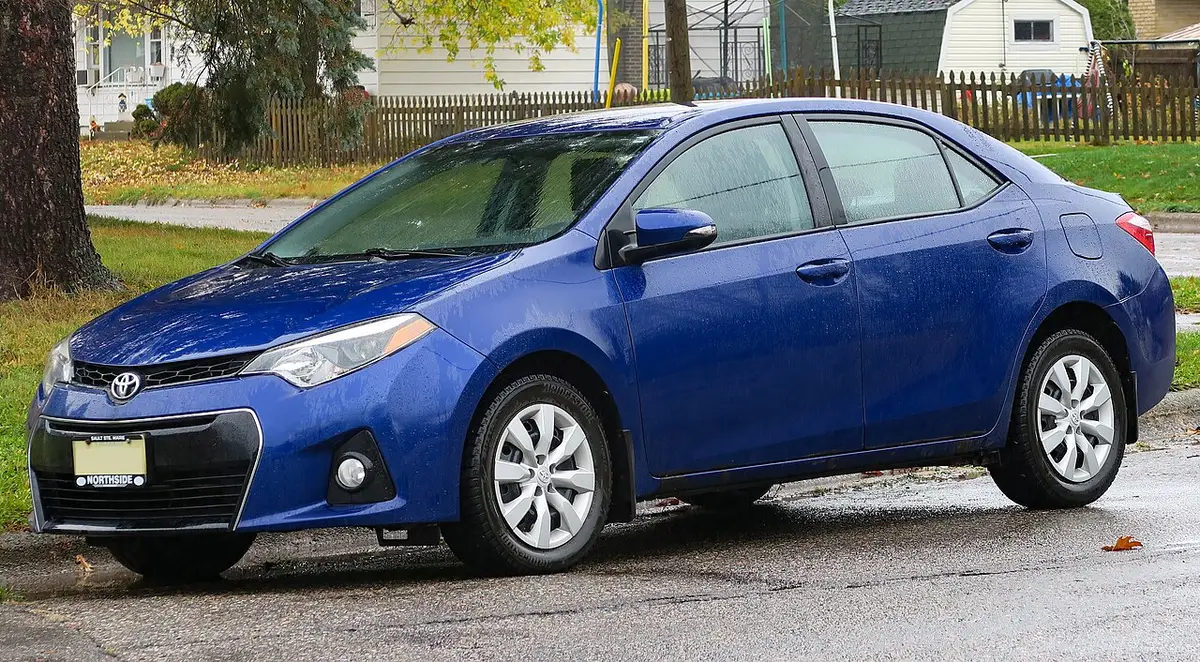
2015 Toyota Corolla
The most reported problem on the 2015 Toyota Corolla is airbag, with 56 complaints, usually around 43,000 miles.
- 219owner complaints
- 1recalls
- 60involved a crash
- 34,000median miles at failure
Newest report Jul 26, 2026 · checked Oct 2, 2026
What is your Corolla doing?
Each one opens a sheet built from the owner reports of that problem on the 2015 model year.
Is the 2015 Toyota Corolla reliable?
The 2015 Toyota Corolla has 219 owner complaints on file with NHTSA, close to the median of 270 for 2015 sedans on this site. Of the 13 Corolla model years since 2014, it has the 3rd most complaints. Complaint counts rise with sales as well as faults, so read what owners report below before deciding.
At a glance
- Next to other model years
- Complaints filed before 2015 aren't in the files this site reads, so the 2015 count runs short and isn't compared with the model years next to it.
- Top problem
- Airbag leads with 56 of the 219 complaints (26%), ahead of brake wear at 18. A quarter of the 35 owners who gave a mileage for airbag saw it by about 24,000 miles, and half by about 43,000.
- Crash, fire and injury reports
- 64 of the 219 complaints (29%) report a crash, a fire or an injury. The typical vehicle on this site sits at 6%, so this one runs well above it. Counted separately (one report can carry more than one), 60 reports mention a crash, 1 mentions a fire and 50 people were hurt. The most crash reports, 40 of 60, fall under airbag.
- Recalls behind the top problems
- Airbag, the one problem here with enough reports to check, has a recall on the same system (20V-024). A recall on the same system doesn't always cover the failure owners describe, so compare its summary with the complaints.
- When owners filed
- Filings peaked in 2015 at 36 (full calendar years only). In 2025 there were 9. So far in 2026, 10 more have come in. Filings on record start in 2015.
When each problem shows up
Each bar covers the middle half of the mileages owners reported for that problem. A quarter saw it earlier, a quarter later. The tick is the median. Most reported: airbag warning light or recall, 56 complaints.
middle half of reports, median tick. The heavier grey bars have 75 or more reports.
Behind you
Around your mileage
Ahead of you
How this compares
219 complaints is 1.3 times fewer than the median 2015 model on this site and 1.2 times fewer than the median 2015 sedan. Among the 10 Corolla model years here it ranks 3rd for complaints. Counts follow sales volume as much as reliability, so a truck that sells 700,000 a year draws more reports than a sedan that sells 200,000.
Service bulletins for the 2015 Toyota Corolla
Toyota filed 323 bulletins and other notices with NHTSA that list the 2015 Toyota Corolla. 44 of them deal with a problem owners have reported on this car. Newest first.
Federal rules make a manufacturer send NHTSA a copy of any notice about a defect that goes to more than one dealer or owner. Most of these are service bulletins, the repair instructions manufacturers send to dealers. NHTSA generally leaves safety recall bulletins out of this file, and recalls are listed separately.
Airbag warning light or recall 1 bulletin · 56 complaints
Some 2005 ? 2022 model year Toyota vehicles that have undergone water intrusion may exhibit a condition in which a musty smell is present. Follow the procedures in this bulletin to remediate the odor and address this condition.
Brakes grind, pulse or wear early 4 bulletins · 18 complaints
TT: Some Toyota vehicles installed with Toyota Complete Maintenance Care (TCMC) brake pads may exhibit a groan or squeak noise in various driving conditions.
Some 2015 ? 2018 model year Toyota vehicles may exhibit brake vibration due to improper lug nut torque. Brake vibration can occur at any time if improper torque is applied to lug nuts. Even one lug nut over or under torqued can cause vibration.
2 more on this problem
TT: On some MY14 ? MY17 Corolla vehicles with less than 10,000 miles, customers may experience a vibration feeling when braking or on deceleration. This can occur at various speeds or pedal application forces.
TT: IN SOME MY14 MY17 COROLLA VEHICLES WITH LESS THAN 10,000 MILES, CUSTOMERS MAY EXPERIENCE A VIBRATION FEELING WHEN BRAKING OR ON DECELERATION. THIS CAN OCCUR AT VARIOUS SPEEDS OR PEDAL APPLICATION FORCES.
Paint peels or body rusts 14 bulletins · 13 complaints
To prevent brake rotor rust from forming during transportation and storage, wheel film will be used instead of a cardboard type of anti-rust cover.
Acid rain results from rainwater or other airborne moisture that become acidic due to industrial chemical impurities in the atmosphere.
12 more on this problem
The condition known as acid rain is caused by airborne chemicals or particles in the atmosphere, which mix with rainwater, nighttime dew, or high humidity to form acidic compounds.
DL: Toyota has received reports of paint peeling on certain vehicles with the original factory-applied Blizzard Pearl or Super White paint colors.
Some 2010 ? 2022 model year Toyota vehicles may exhibit paint stains after the removal of Rapgard?. The paint stains may appear to be under the clear coat but are usually under wrinkles in the Rapgard?.
RE: Toyota has received reports of paint peeling on certain vehicles with the original factory-applied Blizzard Pearl or Super White paint colors.
Toyota has received reports of paint peeling on certain vehicles with the original factory-applied Blizzard Pearl or Super White paint colors.
Region Letter: Toyota has received reports of paint peeling on certain vehicles with the original factory-applied Blizzard Pearl or Super White paint colors.
Dealer Email: Toyota has received reports of paint peeling on certain vehicles with the original factory-applied Blizzard Pearl or Super White paint colors.
Dealer Package: Toyota has received reports of paint peeling on certain vehicles with the original factory-applied Blizzard Pearl or Super White paint colors.
Some 2008 ? 2019 model year Toyota vehicles painted with either 070 Blizzard Pearl or 040 Super White may exhibit peeling paint on one or more metal body panels.
Region Email: Toyota has received reports of paint peeling on certain vehicles with the original factory-applied Blizzard Pearl or Super White paint colors.
Plus 2 older ones not listed here.
Wheel bearing, tires or wheels 3 bulletins · 12 complaints
TT: Front Brake Vibration Key Points: * Issue can occur at any time if improper torque is applied on lug nuts * Over time, even one lug nut over or under torqued, can cause a vibration issue * When lug nuts are over torqued, this causes the rotor to have a ...
SOME 2014 2016 MODEL YEAR COROLLA VEHICLES MAY EXHIBIT REAR WHEEL HOUSE PLATES THAT APPEAR TO BE LOOSE OR HAVE A GAPPING CONDITION TO THE VEHICLE BODY. NEW PARTS HAVE BEEN MADE AVAILABLE TO PREVENT THIS FROM OCCURRING.
1 more on this problem
DURING THE MANUFACTURING PROCESS TIRES ARE MOUNTED ON THE VEHICLE AS MATCHED SETS TO HELP REDUCE CONDITIONS SUCH AS PULLING OR DRIFTING.
Seat belt or seat problems 3 bulletins · 9 complaints
Some 2010 ? 2022 model year Toyota vehicles may exhibit paint stains after the removal of Rapgard?. The paint stains may appear to be under the clear coat but are usually under wrinkles in the Rapgard?.
Some 2010 ? 2021 model year Toyota vehicles may exhibit paint stains after the removal of Rapgard?. The paint stains may appear to be under the clear coat but are usually under wrinkles in the Rapgard?.
1 more on this problem
Some 2014 ? 2015 model year Corolla vehicles may exhibit splitting/separation as a result of poor manufacturing of the Front Seat Cushion Cover.
A/C blows warm or the compressor fails 5 bulletins · 7 complaints
The air conditioning dye injection tool kit has been developed to aid in identifying the location of air conditioning refrigerant leaks. The procedures outlined in this Service Bulletin aid in locating, inspecting, and repairing refrigerant leaks.
The air conditioning dye injection tool kit has been developed to aid in identifying the location of air conditioning refrigerant leaks. Follow the procedures outlined in this service bulletin to aid in locating, inspecting, and repairing refrigerant leaks
3 more on this problem
TT: In certain cases of leaking air conditioning systems, the root cause of the leak is inadvertently overlooked, causing a repeat repair.
The procedure in this bulletin is a general guideline on how to properly diagnose the air conditioning system after a component failure. Refer to the applicable Repair Manual for vehicle specific repair procedures and parts.
Some 2014 - 2015 model year Corolla vehicles may exhibit a condition where the A/C system blows warm air intermittently while the vehicle is at idle. An updated A/C compressor is available to address this condition.
Infotainment, screen or backup camera fails 14 bulletins · 5 complaints
TT: Some customers may encounter Bluetooth® connectivity concerns such as: ?Difficulty to pair the phone. ?Intermittent Bluetooth® failure to connect to the vehicle when first turning on the vehicle.
TT: Some customers may experience poor outgoing Bluetooth sound quality, this can occur for various reasons. Current multimedia systems are designed with the ability to adjust Bluetooth sound quality to compensate for echo or excessive background noise.
12 more on this problem
TT: Some customers may experience a call failure when attempting to call a conference call number that has been saved in their phonebook (ex: ?8005550122,,,1.,2;;;2#?).
TT: For customer concerns of no or poor outgoing sound from the Bluetooth systems there are diagnostics in the repair manual which can be performed to diagnose the condition.
TT: Some customers may experience greyed out buttons or inactive screens (lockouts) while driving. This is to promote safe driving practices and reduce the amount of distractions while driving.
TT: Some customers may experience Bluetooth disconnections or loss of SMS text message functionality on the navigation/audio system with Android phones running OS 4.4 or later.
TT: Some customers may experience Bluetooth connection issues after updating the Android Operating System to 5.x.x (Lollipop) or later.
TT: Some customers may encounter Bluetooth connectivity concerns such as: ? Difficulty pairing the phone. ? Intermittent Bluetooth failure to connect when first turning on the vehicle.
TT: SOME CUSTOMERS MAY EXPERIENCE INTERMITTENT BLUETOOTH DISCONNECTIONS IF THEY TURN OFF BLUETOOTH AUDIO IN THE BLUETOOTH CONNECTION MENU ON AN ANDROID PHONE
TT: Customers may experience connectivity issues when the following conditions are met: The customer's iPhone is operating on iOS9 firmware. The customer's iPhone is connected to the vehicle via Bluetooth.
TT: Some customers may encounter various Bluetooth connectivity concerns after upgrading to iOS 8.0 and later. Conditions typically experienced include inability to pair the iPhone to the system, poor sound quality during phone calls placed through the ...
TT: Customers complain of various Bluetooth connectivity concerns after upgrading to iOS 8.0 and later. Conditions typically experienced include inability to pair the iPhone to the system, poor sound quality during phone calls placed through the ...
Plus 2 older ones not listed here.
Complaints filed by year
36 complaints came in 2015. Owners file in waves when a problem gets press or an investigation, so a spike measures attention as much as failures.
NHTSA investigations
Desiccated air bag inflator rupture. Open.
NHTSA summary
Electrical overstress. Closed sep 19, 2024, led to recall 20V-024.
NHTSA summary
Recalls that include the 2015 Toyota Corolla
Whether your car is included depends on its VIN. Check yours at nhtsa.gov/recalls.
Toyota Motor Engineering & Manufacturing (Toyota) is recalling certain 2011-2019 Corolla, 2011-2013 Matrix, 2012-2018 Avalon, and 2013-2018 Avalon Hybrid vehicles. During certain crashes, the air bag electronic control unit (ECU) may malfunction, possibly disabling the deployment of the air bags and/or seat belt pretensioners.
Risk and remedy
Remedy: Toyota will notify owners, and dealers will inspect the ECU and install a noise filter between the air bag control module and its wire harness, as necessary, free of charge. Owners were notified of the safety risk beginning March 2, 2020. A second letter notifying owners of the remedy repair will be mailed between March 16, 2020 and June 27, 2020. Owners may contact Toyota customer service at 1-888-270-9371. Toyota's numbers for this recall are 20TB03, 20TA03 and 20TA05.
The recall on the 2015 Toyota Corolla, with the owner complaints on each recalled system
Guide NHTSA has an open investigation on this car. What the investigation stages mean
Questions
What is the most common problem on the 2015 Toyota Corolla?
Airbag, with 56 of the 219 complaints. Owners who gave a mileage for it put the median at about 43,000 miles.
At what mileage do 2015 Toyota Corolla problems start?
Of the 125 complaints that give a mileage, a quarter came by about 13,000 miles and half by about 34,000.
How many 2015 Toyota Corolla complaints involve a crash, fire or injury?
64 of them (29%). The typical vehicle on this site is at 6%.
Is there a recall for airbag on the 2015 Toyota Corolla?
Yes, NHTSA lists a recall on the same system: 20V-024. Its summary says which failure it covers, and that isn't always the one owners describe.