First generation (FS)
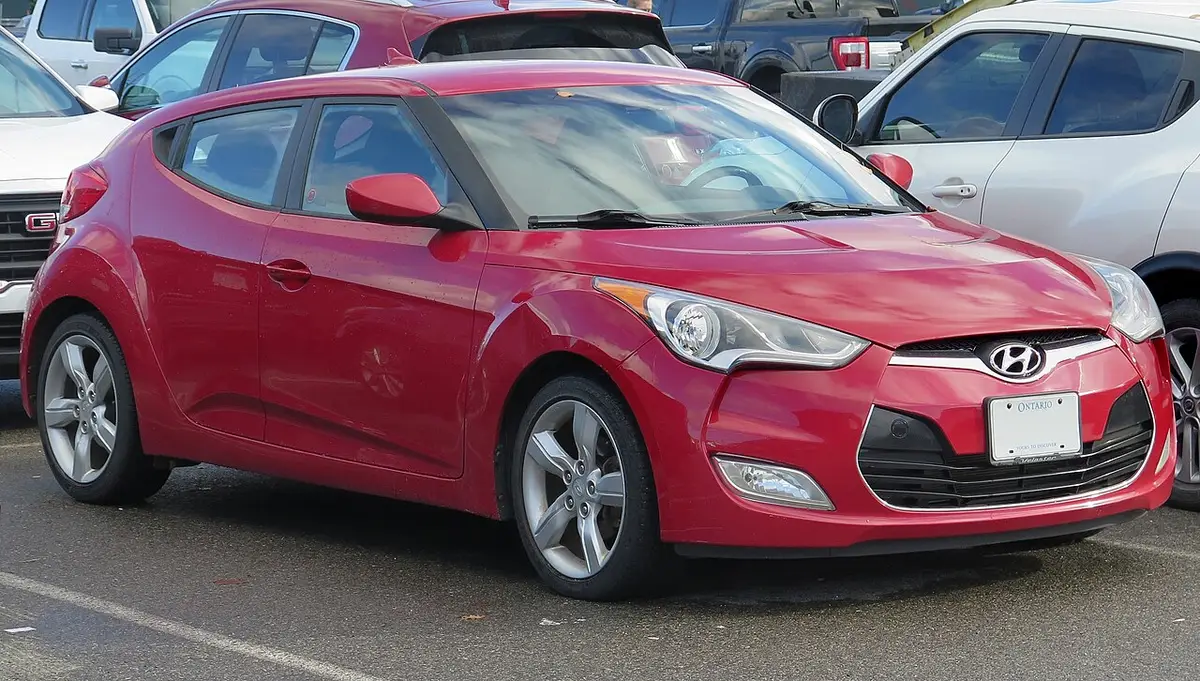
2015 Hyundai Veloster
The most reported problem on the 2015 Hyundai Veloster is engine failure, with 39 complaints, usually around 86,000 miles.
- 137owner complaints
- 2recalls
- 0involved a crash
- 62,000median miles at failure
Newest report Sep 27, 2026 · checked Oct 2, 2026
What is your Veloster doing?
Each one opens a sheet built from the owner reports of that problem on the 2015 model year.
Is the 2015 Hyundai Veloster reliable?
The 2015 Hyundai Veloster has 137 owner complaints on file with NHTSA, close to the median of 151 for 2015 hatchbacks on this site. Of the 7 Veloster model years since 2014, it has the 2nd most complaints. Complaint counts rise with sales as well as faults, so read what owners report below before deciding.
At a glance
- Next to other model years
- Complaints filed before 2015 aren't in the files this site reads, so the 2015 count runs short and isn't compared with the model years next to it.
- Top problem
- Two problems run close. Engine failure has 39 complaints and stalling has 38, out of 137 in all. A quarter of the 15 owners who gave a mileage for engine failure saw it by about 44,000 miles, and half by about 86,000.
- Crash, fire and injury reports
- 10 of the 137 complaints (7%) report a crash, a fire or an injury, about the 6% typical of vehicles on this site. Counted separately (one report can carry more than one), 7 mention a fire and 4 people were hurt.
- Recalls behind the top problems
- engine failure and stalling all have recalls on the same system, and the same campaigns cover them: 20V-746. A recall on the same system doesn't always cover the failure owners describe, so compare its summary with the complaints.
- When owners filed
- Filings peaked in 2021 at 30 (full calendar years only). In 2025 there were 10. So far in 2026, 6 more have come in. Filings on record start in 2015.
When each problem shows up
Each bar covers the middle half of the mileages owners reported for that problem. A quarter saw it earlier, a quarter later. The tick is the median. Most reported: engine failure, knocking or rod bearing, 39 complaints.
middle half of reports, median tick. The heavier grey bars have 75 or more reports.
Behind you
Around your mileage
Ahead of you
How this compares
137 complaints is 2.0 times fewer than the median 2015 model on this site and about the median for a 2015 hatchback. Among the 2 Veloster model years here it ranks 2nd for complaints. Counts follow sales volume as much as reliability, so a truck that sells 700,000 a year draws more reports than a sedan that sells 200,000.
Service bulletins for the 2015 Hyundai Veloster
Hyundai filed 133 bulletins and other notices with NHTSA that list the 2015 Hyundai Veloster. 22 of them deal with a problem owners have reported on this car. Newest first.
Federal rules make a manufacturer send NHTSA a copy of any notice about a defect that goes to more than one dealer or owner. Most of these are service bulletins, the repair instructions manufacturers send to dealers. NHTSA generally leaves safety recall bulletins out of this file, and recalls are listed separately.
Engine failure, knocking or rod bearing 2 bulletins · 39 complaints
A class action lawsuit against Hyundai Motor America (âHMAâ) alleges that certain Hyundai vehicles (âClass Vehiclesâ) were manufactured, marketed, sold, and/or leased with an engine defect that can result in sudden engine seizure, stalling, engine ...
Certain vehicles listed below may experience the Check Engine warning lamp illuminated with DTC P1326. Follow the procedure to inspect the vehicle and replace the engine and/or update the engine ECU software (if new ROM is available) based on the inspection ...
Engine stalls or loses power while driving 1 bulletin · 38 complaints
If you are servicing a vehicle with a transmission slipping concern, follow the Service Procedure shown below and perform a stall test. This TSB provides a procedure to test each clutch in the transmission.
Check engine light or misfire 8 bulletins · 23 complaints
If you are servicing an applicable vehicle with a âCheck Engineâ light on and one or more of the DTC listed below, follow the repair procedure and replace the related solenoid and oil pressure harness.
If you are servicing a vehicle with the DTC or symptoms listed below, refer to the Service Procedure to diagnose the condition.
6 more on this problem
Certain 2012-2016 1.6L VELOSTER (FS) vehicles may experience a check engine warning light with the following DTC(s) found stored in the Engine Control Module (ECM): ? DTC P0455 - Evaporative emission system-Leak detected (Large leak) ? DTC P0456 - Evaporative ...
Some Veloster (FS) and Sonata Hybrid (YF HEV) vehicles may experience a check engine warning light ON with any of the following DTCs found stored: ? P0442 - Evaporative System (EVAP) - Small Leak ? P0455 - Evaporative System (EVAP) - Large Leak ? P0456 - ...
This bulletin provides information related to ECM (Engine Control Module) software update for diagnostic trouble code (DTC) P0441 - Canister Purge Valve (CPV) - Incorrect CPV Flow. There is no vehicle performance concern associated with this condition.
HYUNDAI 15 MY VELOSTER: THIS BULLETIN INFORMATION SUPERSEDES TSB 14-01-059. INFORMATION IS PROVIDED ON ENGINE CONTROL MODULE (ECM) SOFTWARE UPDATE WHERE NO DRIVABILITY SYMPTOMS INVOLVED BUT EXPERIENCE CHECK ENGINE LIGHT ON. *LJ UPDATED 9/15/15. *PE
HYUNDAI VELOSTER TURBO: SOME 15 MY VELOSTER TURBO VEHICLES, THE INTERCOOLER MAY REQUIRE REPLACEMENT DUE TO A RESTRICTION IN THE PRESSURE PORT WHICH COULD REDUCE ENGINE POWER & CHECK ENGINE LIGHT COULD ILLUMINATE WITH DTC P0299. *LJ
HYUNDAI 2015 MY VELOSTER: BULLETIN INFORMATION REGARDING ECM CHECK ENGINE LIGHT ON WITHOUT DTC STORED WHICH REQUIRES SOFTWARE UPDATE. *LJ
Engine knocking or ticking 3 bulletins · 20 complaints
Hyundai is conducting a campaign to enhance the knock sensor software to detect abnormal engine bearing noise before potentially severe engine damage occurs.
Hyundai is conducting a service campaign to enhance the knock sensor software to detect abnormal engine bearing noise before potentially severe engine damage occurs.
1 more on this problem
Hyundai is conducting a product improvement campaign to enhance the knock sensor software to detect abnormal engine bearing noise before potentially severe engine damage occurs.
Rod bearing failure 6 bulletins · 14 complaints
The warranty coverage for engine repair or replacement regarding engine damage or malfunction from connecting rod bearing wear has been extended to 15 years or 150,000 miles from the date of original retail delivery or date of first use, whichever occurs ...
Certain vehicles listed below may experience the Check Engine warning lamp illuminated with DTC P1326 and/or an engine concern/noise related to connecting rod bearing wear or damage.
4 more on this problem
Certain vehicles may experience the Check Engine warning lamp illuminated with DTC P1326 and/or engine may exhibit abnormal noise, or no crank/no start condition related to connecting rod bearing wear or damage.
The Powertrain warranty coverage for certain engine repairs and/or replacement where the engine damage or malfunction is related to connecting rod bearing wear, has been extended to 15 years or 150,000 miles from the date of original retail delivery or date ...
Certain vehicles that have completed Service Campaign 966 may experience the Check Engine warning lamp illuminated with DTC P1326 and/or an engine concern/noise related to connecting rod bearing wear or damage.
The Powertrain warranty coverage for certain engine repairs and/or replacement where the engine damage, defect, or failure is related to connecting rod bearing wear, has been extended to 15 years or 150,000 miles from the date of original retail delivery or ...
Brakes grind, pulse or wear early 2 bulletins · 11 complaints
If you are servicing an applicable vehicle with a âCheck Engineâ light on and one or more of the DTC listed below, follow the repair procedure and replace the related solenoid and oil pressure harness.
Some subject vehicles may experience the illumination of various warning lamps including the brake warning lamp and other lamps.
Complaints filed by year
30 complaints came in 2021, 3.3 times the year before. Owners file in waves when a problem gets press or an investigation, so a spike measures attention as much as failures.
NHTSA investigations
Hyundai and kia abs module fires. Open.
NHTSA summary
Engine fires. Closed feb 5, 2024, led to recall 23V-877.
NHTSA summary
Recalls that include the 2015 Hyundai Veloster
Whether your car is included depends on its VIN. Check yours at nhtsa.gov/recalls.
Hyundai Motor America (Hyundai) is recalling certain 2011-2015 Elantra, Genesis Coupe, Sonata Hybrid, 2012-2015 Accent, Azera, Veloster, 2013-2015 Elantra Coupe, Santa Fe, 2014-2015 Equus, 2010-2012 Veracruz, 2010-2013 Tucson, 2015 Tucson Fuel Cell, and 2013 Santa Fe Sport vehicles. The Anti-Lock Brake System (ABS) module may leak brake fluid internally and cause an electrical short, which can result in an engine compartment fire while parked or driving.
Risk and remedy
Remedy: Owners are advised to park outside and away from structures until the recall repair is complete. Dealers will replace the ABS fuse, free of charge. Owner notification letters were mailed April 10, 2024 through October 11, 2024. Owners may contact Hyundai customer service at 1-855-371-9460. Hyundai's number for this recall is 251.
Hyundai Motor America (Hyundai) is recalling certain 2015-2016 Veloster, 2012 Santa Fe, 2011-2013 Sonata Hybrid, and 2016 Sonata Hybrid vehicles. The connecting rod bearings inside the engine may wear prematurely, which over time can result in engine damage.
Risk and remedy
Remedy: Hyundai will notify owners, and dealers will inspect the engine. If bearing damage is found, the engine will be replaced. Dealers will also install a software update containing a new Knock Sensor Detection System (KSDS). Repairs will be performed free of charge. The recall began March 31, 2021. Owners may contact Hyundai customer service at 1-855-371-9460. Hyundai's number for this recall is 198.
All 2 recalls on the 2015 Hyundai Veloster, with the owner complaints on each recalled system
Guide NHTSA has an open investigation on this car. What the investigation stages mean
Questions
What is the most common problem on the 2015 Hyundai Veloster?
Engine failure, with 39 of the 137 complaints. Owners who gave a mileage for it put the median at about 86,000 miles.
At what mileage do 2015 Hyundai Veloster problems start?
Of the 66 complaints that give a mileage, a quarter came by about 35,000 miles and half by about 62,000.
How many 2015 Hyundai Veloster complaints involve a crash, fire or injury?
10 of them (7%). The typical vehicle on this site is at 6%.
Is there a recall for engine failure on the 2015 Hyundai Veloster?
Yes, NHTSA lists a recall on the same system: 20V-746. Its summary says which failure it covers, and that isn't always the one owners describe.